

Ingeniería Civil Matemática

Informaciones
- Contacto:
- Departamento de Ingeniería Matemática
- Dirección:
- Av. Beauchef 850, 2do Piso, Santiago
- Telefono:
- +562 29784417
- E-mail:
- colegios@ing.uchile.cl
- Grado Académico
- Licenciado/a en Ciencias de la Ingeniería mención Matemática
- Título profesional
- Ingeniero/a Civil Matemático/a
- Facultad o Instituto
- Facultad de Ciencias Físicas y Matemáticas
- Duración
- 11 semestres académicos, jornada diurna
Este Ingeniero se especializa en el uso de técnicas avanzadas de la matemática para modelar y resolver problemas complejos de Ingeniería y Ciencias. Su formación abarca las ecuaciones diferenciales y la teoría de control, las probabilidades, la optimización y el análisis numérico, las matemáticas discretas y la informática. Estas herramientas le permiten traducir los problemas a un lenguaje matemático, resolverlos numéricamente con la ayuda del computador, y obtener información cualitativa y cuantitativa acerca de las soluciones. Generalmente, trabajan en colaboración con otros ingenieros, aunque su formación les permite realizar aportes significativos en todas las áreas que requieren matemáticas avanzadas.
Admisión
Proceso de Admisión Regular 2024:
El ingreso a esta carrera se realiza únicamente a través del Plan Común de Ingeniería y Ciencias de la Facultad de Ciencias Físicas y Matemáticas. Este plan común permite, luego de cursar dos años académicos, elegir entre una de las 9 especialidades de Ingeniería, Geología o las licenciaturas de Astronomía, Física o Geofísica.
| Código de postulación: | 11045 | |||
| Vacantes 2024: | 730 | |||
| Revisa los requisitos generales de postulación a la Universidad de Chile. | ||||
Requisitos y ponderaciones Admisión 2024:
| Notas de Enseñanza Media | 10% |
| Ránking de Notas | 25% |
| Prueba PAES de Competencia Lectora | 10% |
| Prueba PAES de Competencia Matemática 1 | 20% |
| Prueba PAES de Competencia Matemática 2 | 20% |
| Prueba PAES de Ciencias | 15% |
Procesos de Admisión Especial 2024:
| Vacantes BEA (ver más) | 55 |
| Vacantes SIPEE (ver más) | 25 |
| Vacantes PACE (ver más) | 1 |
| Vacantes Ed. Media en el Extranjero (ver más) | 5 |
| Vacantes para Deportistas Destacados/as (ver más) | 15 |
| Vacantes para Est. de Pueblos Indígenas (ver más) | 30 |
| Vacantes para Est. Sit. de Discapacidad (ver más) | 2 |
| Vacantes Más Mujeres Científicas (+MC) (ver más) | 85 |
| Vacantes Cupos Explora-UNESCO (ver más) | 3 |
Campo laboral
Se desempeña en empresas de los sectores minero, forestal, energético, financiero, transporte, planificación, así como en ministerios y organismos de gobierno. Los que optan por el perfeccionamiento, pueden continuar sus estudios para la obtención del Magíster y Doctorado y la carrera científica en centros de investigación y universidades nacionales y extranjeras.
Video: nuestros egresados
Perfil de Egreso
El Ingeniero y la ingeniera Civil Matemático(a) de la Universidad de Chile es un(a) profesional con sólida formación en ciencias básicas y de la ingeniería, que modela, analiza y resuelve problemas haciendo uso de técnicas y herramientas matemáticas avanzadas. Posee la capacidad de autoaprendizaje para plantear y analizar soluciones alternativas, en concordancia con los nuevos conocimientos en su área de especialización.
Posee conocimientos sólidos en herramientas conceptuales de diversas áreas de las matemáticas, tales como análisis, simulación numérica, ecuaciones diferenciales, matemáticas discretas, optimización y probabilidades, entre otras. Su capacidad analítica le da la independencia para analizar su entorno con una actitud creativa y crítica.
La formación dada habilita al egresado y egresada para desenvolverse en los ámbitos de las ciencias exactas y naturales y ciencias de la ingeniería. Dichos ámbitos se describen a continuación:
- Investigar y generar conocimiento en las distintas ciencias exactas y naturales, tales como matemáticas, física y biología.
- Evaluar, concebir, modelar y resolver problemas provenientes de distintas áreas tales como: medicina, astronomía, minería, economía y finanzas, computación, ciencias sociales.
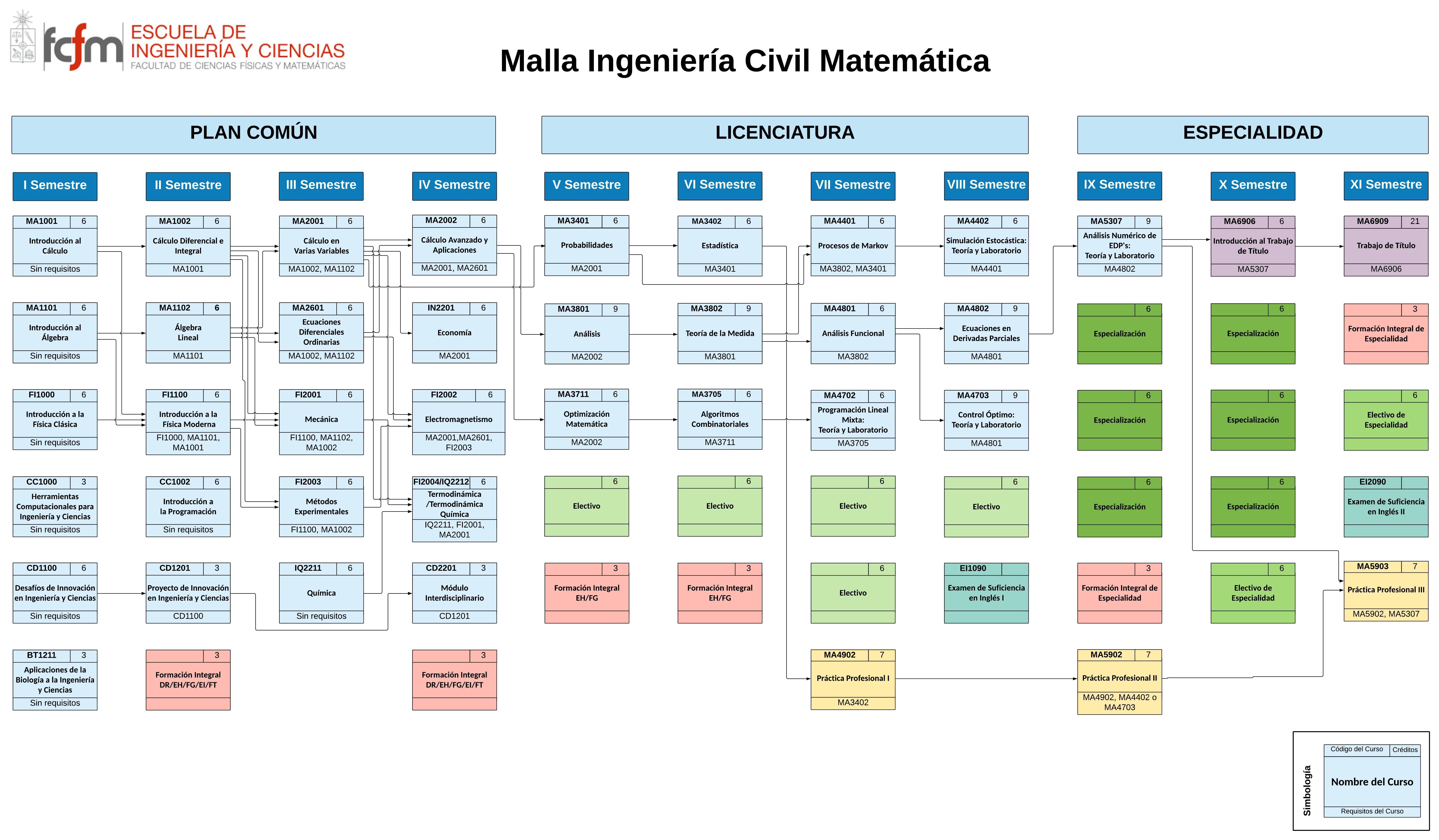
Plan de formación
Nota: Los planes de formación podrán ser modificados en función del mejoramiento contínuo de la carrera.
Plan Común: Duración 4 semestres |
|||
Primer Año |
|||
| Código | Curso - SEMESTRE I | Línea Formativa | Créditos |
| MA1001 | INTRODUCCIÓN AL CÁLCULO | Básico | 6 |
| MA1101 | INTRODUCCIÓN AL ÁLGEBRA | Básico | 6 |
| FI1000 | INTRODUCCIÓN A LA FÍSICA CLÁSICA | Básico | 6 |
| CC1000 | HERRAMIENTAS COMPUTACIONALES PARA INGENIERÍA Y CIENCIAS | Básico | 3 |
| CD1100 | DESAFÍOS DE INNOVACIÓN EN INGENIERÍA Y CIENCIAS | Básico | 6 |
| BT1211 | APLICACIONES DE LA BIOLOGÍA A LA INGENIERÍA Y CIENCIAS | Básico | 3 |
| Código | Curso - SEMESTRE II | Línea Formativa | Créditos |
| MA1002 | CÁLCULO DIFERENCIAL E INTEGRAL | Básico | 6 |
| MA1102 | ÁLGEBRA LINEAL | Básico | 6 |
| FI1100 | INTRODUCCIÓN A LA FÍSICA MODERNA | Básico | 6 |
| CC1002 | INTRODUCCIÓN A LA PROGRAMACIÓN | Básico | 6 |
| CD1201 | PROYECTO DE INNOVACIÓN EN INGENIERÍA Y CIENCIAS | Básico | 3 |
| EH/EI/FG/DR/FT | CURSOS DE FORMACIÓN GENERAL, HUMANISTAS, IDIOMAS Y DEPORTES | Complementaria | 3 |
Segundo Año |
|||
| Código | Curso - SEMESTRE III | Línea Formativa | Créditos |
| MA2001 | CÁLCULO EN VARIAS VARIABLES | Básico | 6 |
| MA2601 | ECUACIONES DIFERENCIALES ORDINARIAS | Básico | 6 |
| FI2003 | MÉTODOS EXPERIMENTALES | Básico | 6 |
| FI2001 | MECÁNICA | Básico | 6 |
| IQ2211 | QUÍMICA | Básico | 6 |
| Código | Curso - SEMESTRE IV | Línea Formativa | Créditos |
| IN2201 | ECONOMÍA | Básico | 6 |
| MA2002 | CÁLCULO AVANZADO Y APLICACIONES | Básico | 6 |
| FI2002 | ELECTROMAGNETISMO | Básico | 6 |
| FI2004/IQ2212 | TERMODINÁMICA / TERMODINÁMICA QUÍMICA | Básico | 6 |
| CD2201 | MÓDULO INTERDISCIPLINARIO | General | 3 |
| EH/EI/FG/DR/FT | CURSOS DE FORMACIÓN GENERAL, HUMANISTAS, IDIOMAS Y DEPORTES | Complementaria | 3 |
Tercer Año |
|||
| Código | Curso - SEMESTRE V | Línea Formativa | Créditos |
| MA3401 | PROBABILIDADES | Especializada | 6 |
| MA3801 | ANÁLISIS | Especializada | 9 |
| MA3711 | OPTIMIZACIÓN MATEMÁTICA | Especializada | 6 |
| ELECTIVO | Especializada | 6 | |
| FORMACIÓN INTEGRAL | Complementaria | 3 | |
| Código | Curso - SEMESTRE VI | Línea Formativa | Créditos |
| MA3402 | ESTADÍSTICA | Especializada | 6 |
| MA3802 | TEORÍA DE LA MEDIDA | Especializada | 9 |
| MA3705 | ALGORITMOS COMBINATORIALES | Especializada | 6 |
| ELECTIVO | Especializada | 6 | |
| FORMACIÓN INTEGRAL | Complementaria | 3 | |
Cuarto Año |
|||
| Código | Curso - SEMESTRE VII | Línea Formativa | Créditos |
| MA4401 | PROCESOS DE MARKOV | Especializada | 6 |
| MA4801 | ANÁLISIS FUNCIONAL | Especializada | 6 |
| MA4702 | PROGRAMACIÓN LINEAL MIXTA: TEORÍA Y LABORATORIO | Especializada | 6 |
| ELECTIVOS | Especializada | 12 | |
| MA4902 | PRÁCTICA PROFESIONAL I | Especializada | 7 |
| Código | Curso - SEMESTRE VIII | Línea Formativa | Créditos |
| MA4402 | SIMULACIÓN ESTOCÁSTICA: TEORÍA Y LABORATORIO | Especializada | 6 |
| MA4802 | ECUACIONES EN DERIVADAS PARCIALES | Especializada | 9 |
| MA4703 | CONTROL ÓPTIMO: TEORÍA Y LABORATORIO | Especializada | 9 |
| ELECTIVOS | Especializada | 6 | |
| EI1090 | EXAMEN DE SUFICIENCIA EN INGLÉS I | ||
Quinto Año |
|||
| Código | Curso - SEMESTRE IX | Línea Formativa | Créditos |
| MA5307 | ANÁLISIS NUMÉRICO DE EDP´S: TEORÍA Y LABORATORIO | Especializada | 9 |
| ESPECIALIZACIÓN | Especializada | 18 | |
| FORMACIÓN INTEGRAL DE ESPECIALIDAD | General | 3 | |
| MA5902 | PRÁCTICA PROFESIONAL II | Especializada | 7 |
| Código | Curso - SEMESTRE X | Línea Formativa | Créditos |
| MA6906 | INTRODUCCIÓN AL TRABAJO DE TÍTULO | Especializada | 6 |
| ESPECIALIZACIÓN | Especializada | 18 | |
| ELECTIVO DE ESPECIALIDAD | Especializada | 6 | |
Sexto Año |
|||
| Código | Curso - SEMESTRE XI | Línea Formativa | Créditos |
| MA6909 | TRABAJO DE TÍTULO | Especializada | 21 |
| ELECTIVO DE ESPECIALIDAD | Especializada | 6 | |
| FORMACIÓN INTEGRAL DE ESPECIALIDAD | General | 3 | |
| EI2090 | EXAMEN DE SUFICIENCIA EN INGLÉS II | ||
| MA5903 | PRÁCTICA PROFESIONAL III | Especializada | 7 |
Departamento de Pregrado
Vicerrectoría de Asuntos Académicos